Procedural Audio Pipelines
Principles, Promises, Problems, and Practices
- How do we get from infinitely complex real-world sounds to compact and convincing interactive models for virtual worlds?
- How do we realise the potential, and overcome the practical problems, of procedural audio?
- Can new pipelines and workflows make developing more realistic models easier?
Procedural audio — the real-time synthesis of real-world sounds — has long offered the promise of more dynamic, authentic game audio experiences, but like its musical cousin, physical modelling, is held back by practical problems of performance, realism, scalability, and development effort. Samples, libraries, randomisation, layering, middleware tricks, and AI-generated variants are often cheaper, easier, and better-sounding - so why develop procedural models?
Two procedural audio/music tool-builders — Chris Nash and Aaron McLeran — take a lively, opinionated tour through the history, hype, trough of disillusionment, and stubborn promise of procedural audio. From Farnell and Pure Data, through middleware and MetaSounds, to modern toolchains such as Klang Studio and Rhizome, we ask how procedural audio becomes less of an academic exercise and more of a live, engaging creative workflow, as part of a practical production pipeline that not only makes it easier to explore and experiment with new models, but iterate and refine them into game-ready sound assets. We discuss rapid prototyping, live editing modes, integrated analysis tools, and new application interfaces and file formats to support integrations and interoperability.
This talk reviews the state of the art, breaks down the complexity of the process, and asks how tools and workflows can transform the challenge of developing new models - addressing production pain points, necessary compromises, and opportunities for more dynamic models.
Through practical examples, the session follows a procedural sound from field recording to runtime: analysing the source, identifying sonic features and behaviour, developing and refining models, and integrating it into a live interactive world. The speakers highlight the critical role of flexible workflows and fast feedback loops that fluidly weave visual analysis, critical listening, and live code editing – presenting new techniques and technologies to not only generate and rapidly prototype ideas, but refine them into polished, authentic, production-ready sound.
Specific tools and techniques are discussed in the context of the forthcoming open-world game, This Little World, a 1:1 model of Britain, developing new procedural techniques in graphics, gameplay, audio, and music to create vast, yet intricate and varied virtual worlds.
A supporting project, Future Sound of Bristol, provides a playable technical demo and audio development playground for the game (download), developed specifically for the ADC conference and community to showcase concepts discussed in the talk – with an update for ADC26, opening the world to developers as a sandbox for discovering, exploring, creating, and testing their own procedural sounds and soundtracks, part of a wider collaboration between the speakers to develop the tools, resources, and wider ecosystem of procedural audio and music.
This talk is suitable for practitioners of all abilities, and especially recommended for those interested in game sound, interactive audio, procedural modelling, and generative sound techniques.
RELATED PROJECTS
Klang / K++ — a lightweight C++ extension designed for concise, portable expression of audio processes, adding audio syntax and semantics to native C++ projects, including plugins, apps, web (via WASM) and game middleware (Unreal, Unity).
Klang Studio / rapIDE — a C++ IDE designed for rapid audio prototyping, in Klang and C++, supporting live code editing, runtime hot-swapping, instant auditioning, visual analysis, and tests - supporting live audio development of synth and effect plugins inside the DAW (as a VST/AU).
Rhizome Audio — a new real-time node-graph procedural audio tool that features live-editing, extensive tools for asset management, and integrations with DAWs, audio middleware (including Klang Studio), and game engines."
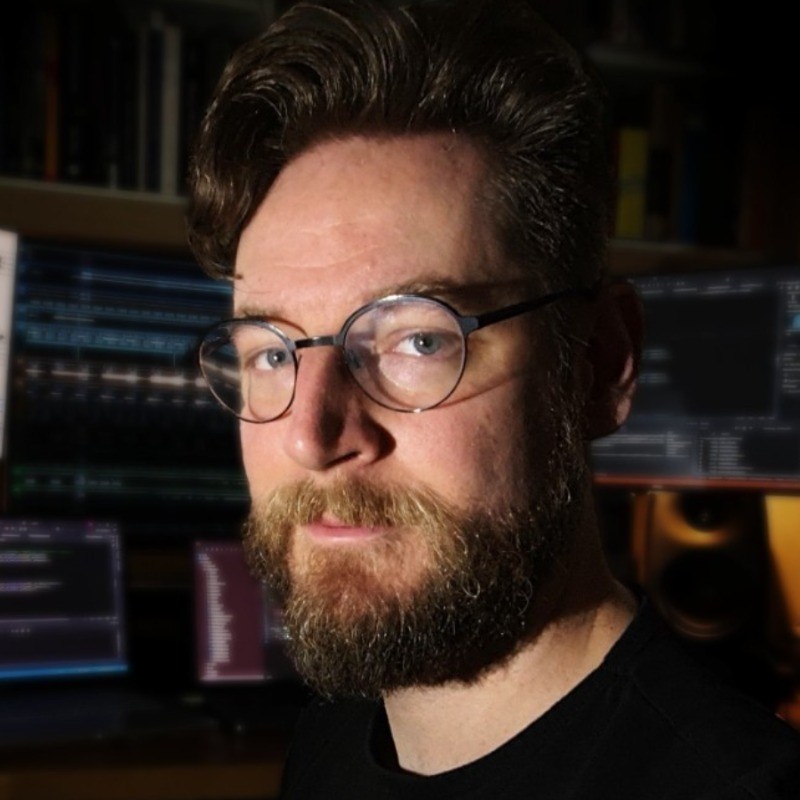
Chris Nash
Director / Founder
nash.audio
Chris Nash is a software developer, composer, educator and researcher in things that go beep in the night. Following a PhD on music software design at Cambridge, he has worked on technology and music projects across academia and industry, including for the BBC, Steinberg/Yamaha, and multiple start-ups, and independently develops and maintains several software projects, specialising in computer music and making music programming more accessible, including Manhattan (a hybrid DAW/programming language), Klang (a C++ dialect for audio), rapIDE (a plug-in based C++ IDE) and reViSiT (an award-winning plug-in based sound tracker) - and the forthcoming open-world game, This Little World (featuring The Future Sound of Bristol).
Dr Nash is the architect of pointblank (London)’s pioneering MuSE (Music Systems Engineering) course, developed in collaboration with industry to be the world's first professional audio developer degree programme, as well as Senior Lecturer in Software Development for Audio, Sound, and Music at UWE Bristol. In 2022, Chris founded nash.audio, a non-profit organisation supporting creativity and learning in music technology, and the development of tools for audio programming.

Aaron McLeran
Founder
Rhizome Audio
Aaron McLeran is the founder of Rhizome Audio, where he is building a node-graph procedural audio plugins and game engine integration tools for real-time audio. He served as Audio Engine Director at Epic Games from 2015–2026, where he was the company's first audio programmer, developed Unreal Engine's cross-platform audio renderer — shipped under a live Fortnite service — and led the team that built MetaSounds for UE5. Earlier in his career, he co-created procedural music systems for Spore in collaboration with Brian Eno, was a technical sound designer on Dead Space 2, and was an audio programmer on several Call of Duty games and Guild Wars 2. Aaron holds an M.S. in physics from Notre Dame and an M.S. in media arts and technology (MAT) from UC Santa Barbara, where he studied under Dr. Curtis Roads.